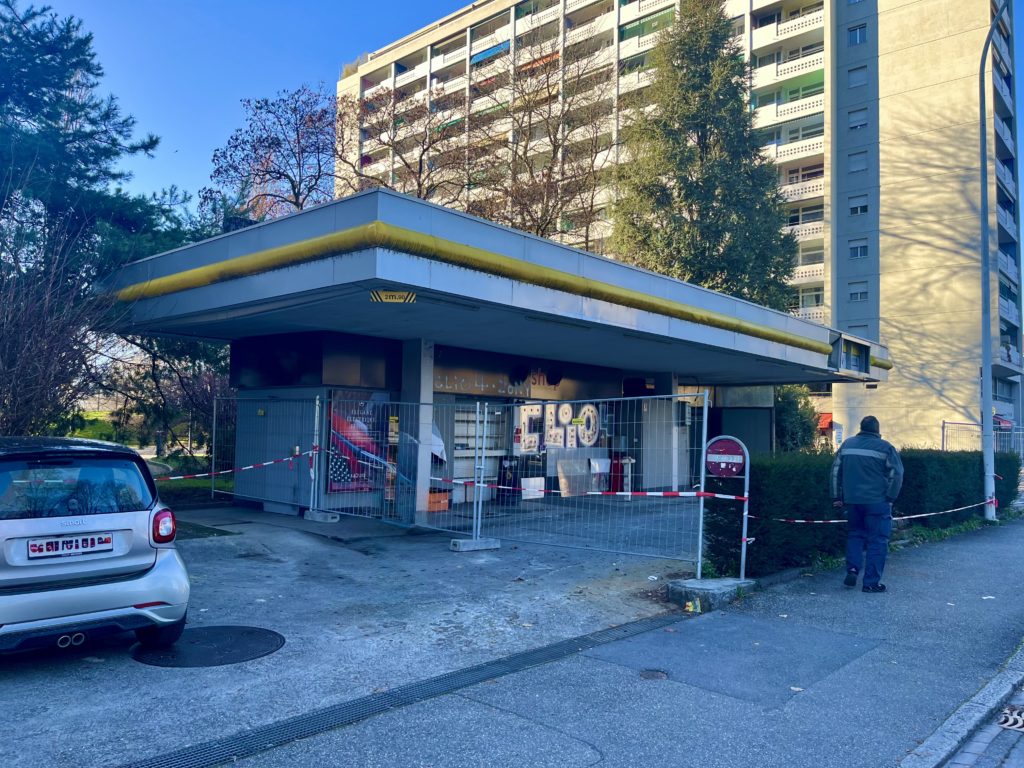
Réaménagement d’une station d’essence désaffectée – projet interdisciplinaire et collaboratif.
Urban Shelter.
Concours d’idée pour des cabanes urbaines à Genève – projet collaboratif
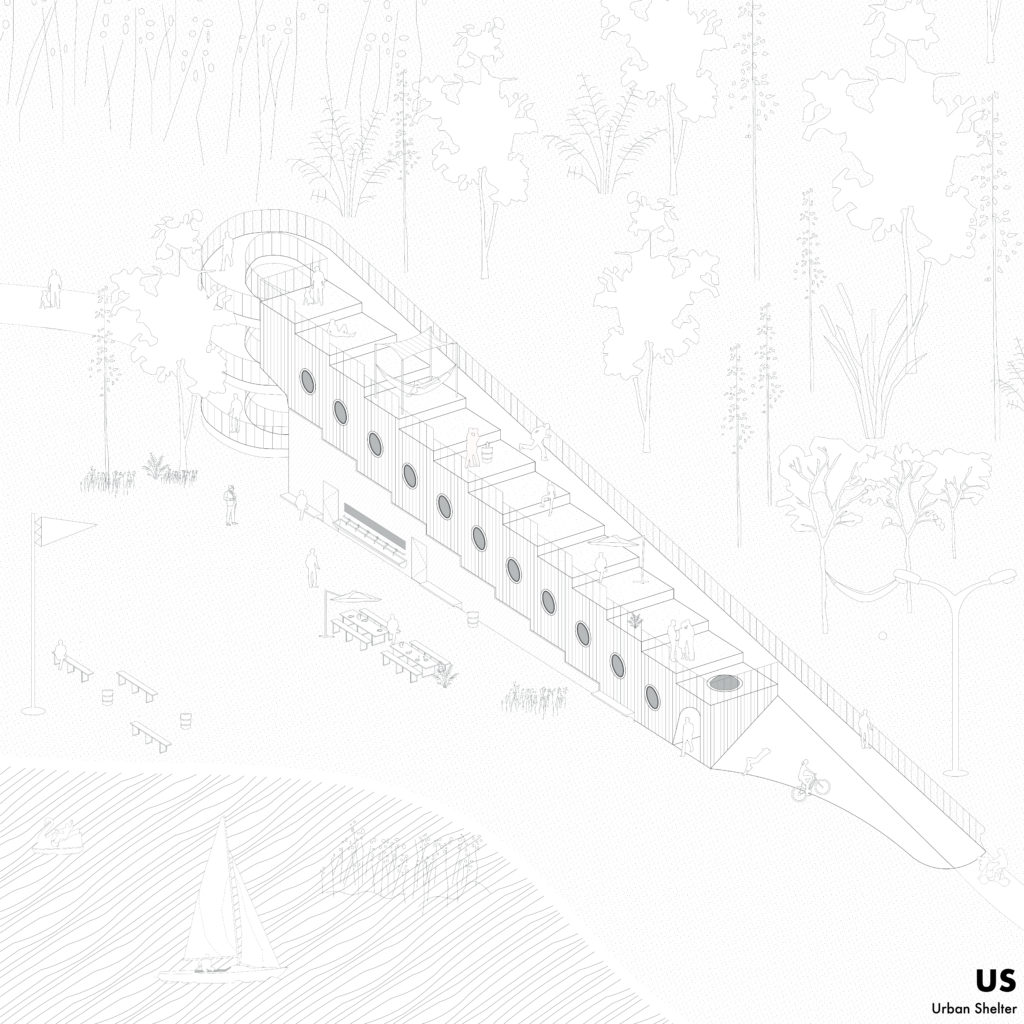
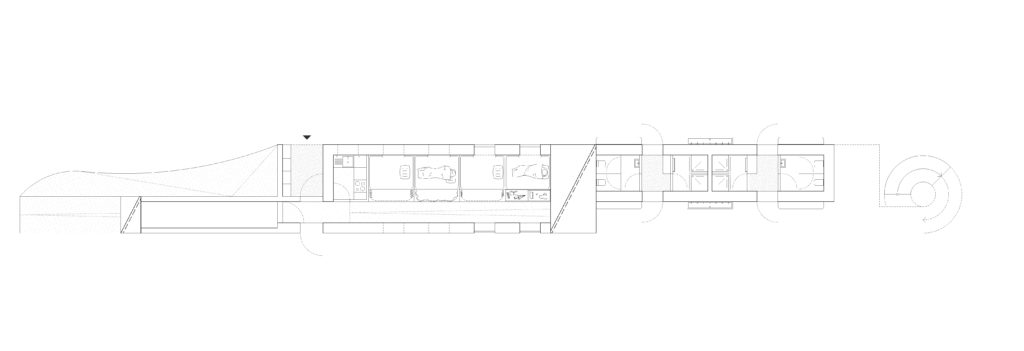
With its lake, the jet d’eau, the Alps, banks and international organizations the Swiss city of Geneva, reflects an image of prosperity and prestige throughout the world. In spite of this quality of life, a growing segment of the population finds itself in a precarious situation that contrasts with the extreme richness of Geneva and the Swiss context by extension. A certain number of people are forced to live on the street, if only for a short period of time. Paradoxically, the accuracy of the state’s system tends to neglect this reality by remaining very vague about the precise number of this population. However, the various associations for the homeless regularly worries about the lack of means and infrastructures. The homeless constitute a very heterogeneous population with very varied problematics. Within the framework of this research, the project seeks to provide an answer to the loss of housing temporary or lasting. Furthermore to deprive access to basic means, in addition to the loss of housing expresses in our sedentary society, an extreme form of social exclusion. The proposed system seeks to respond to both physical and social needs, creating a fusion between shelter and public space. The project offers a flexible solution to the existing infrastructures in Geneva, capable of absorbing variable frequentations according to the period of the year and the socio-economic context. Inspired by mountain huts very common in the Swiss landscape and its local population, the project consists of a dormitory (of about ten beds) organized in terraces in order to offer a certain intimacy to each user while producing a piranesian collective space. Each unit is designed as a small room equipped with storage space, curtains and windows so that visitors can make this small space their own. The access ramp to each unit also defines a public path on the roof, where the particular layout of the beds creates common terraces. The sanitary facilities and a small common kitchen is located in the lower part of the shelter in order to meet the various primary needs. A medical and social service is set up by the city, in order to guarantee a daily follow-up of the nomadic inhabitants as well as the management of the building. The function determines the form and the form offers multiple uses by inviting the public to walk and lounge on the roof. This, in the hope of creating a certain social mix, but also to offer to the users, quality spaces that go beyond the basic shelter. These urban devices will be located in emblematic places in the city of Geneva, in order to symbolically mark the community’s involvement in the problem of homelessness. This satellite implantation not only responds to the nomadic way of life of this population, but also offers public belvederes oriented to the most striking panoramas of the city. The project evokes and supports an alternative lifestyle accepted and included in the public infrastructure, a way to offer some dignity to this minority.
Oil is more
Concours d’idée pour la reconversion des citernes de Vernier – projet interdisciplinaire et collaboratif
Today‘s cities and people’s lifestyles are tightly coupled to the oil industry. Over the ages, different energy sources have been used. Nowadays, oil has become the dominant energy source. Most industrial sites require wide, flat areas of land, and buildings for production and storage of these fuels. In addition, large scale infrastructures and transportation are necessary. As a result, these sites are historically placed outside of cities; cities that are growing thanks to the same prosperity that these industries and energy sources linking production and consumption bring. A mutual dependency between cites and industries has developed. Industrial and energetical changes has resulted in some new technologies and lifestyles. So, what is happening on these areas in today’s situation where the urban sprawl has enveloped these sites? And what will these sites become once the demand of oil diminishes, is displaced, or ends?
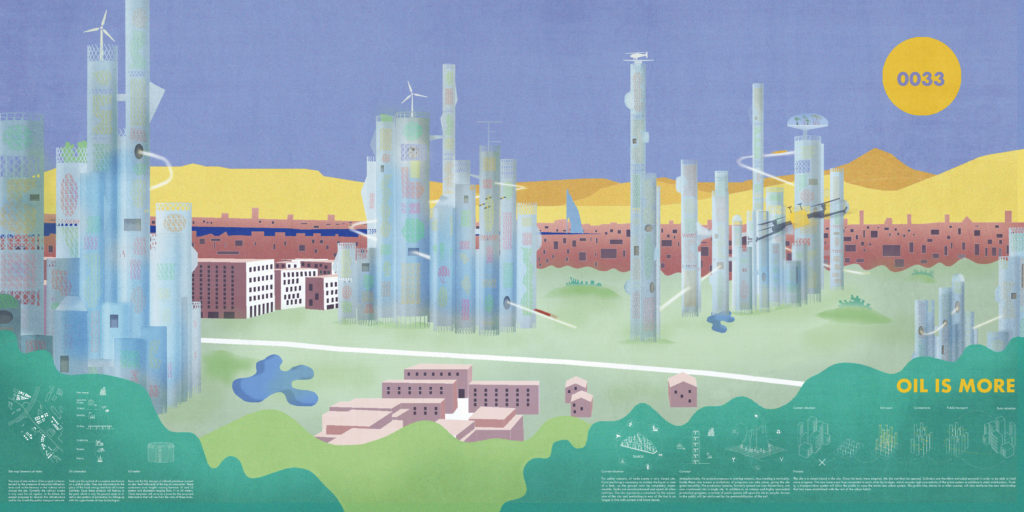
This project is focusing on the city of Geneva, Switzerland. Its urban area contains important oil tanks that rely on pipelines. Presently, they are dangerous and are restricting the city’s growth. These sites serve only one purpose, and they are closed and unwelcoming. Furthermore, with new and varied energy sources available today, these specific important oil tankers are becoming less important. In a foreseeable future, they even could become obsolete.
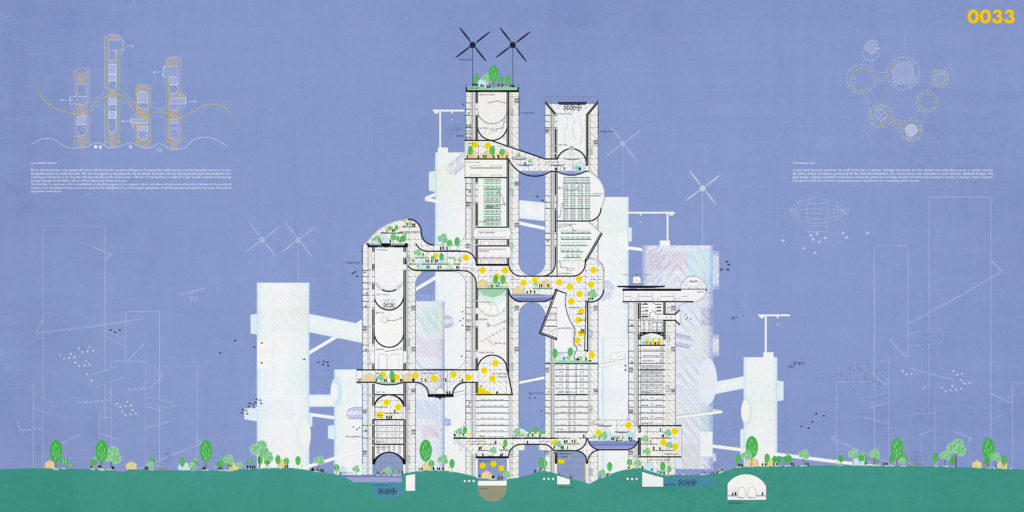
Oil is more, once the petrol has left the site, propose a new happy urban area that grows above the existing tankers. The site becomes open and public. These areas can instead start to produce what is necessary for the city – such as food or energy. These oil tankers can evolve into a vertical autonomous multi-functional industry with mixed uses and shapes. Oil is more offers a vision of a new industry without petrol, where in the same system you can produce energy, grow food, recycle, and have social activities that connect this new industry to the ever-growing metropolis.
A cylindrical shape is a pragmatic choice for storing goods. Therefore, Oil is more follows that logic but adds in the production and consumption as well as the storage and social interactions, all in one vertical and connected new site. An important feature is to open the ground floor and make it a public space with leisure and cultural facilities. Then, by seizing the opportunity to utilise the existing tanker’s shape, the project grows above. As they expand vertically; a new functional “skin” is created. That gap space that is created is used for all the technical aspects and vertical circulations of the project. Within that skin, a drone platform or energy source can be placed too. This skyscraper in thought with a mesh structure that once you connect these towers together, all the system rigidifies. The main programmes are contained into the central volumes. Oil is more works similarly to an industrial site but adds a self-sufficient dimension within a vertical skyscraper. Hence, the programmes are correlated. For example, the stored soil and water produce natural fertilisers and energy. They are used locally and transformed into food in the vertical farms. In the same skyscraper, the food produced can be eaten and shared before being transformed into compost and recycled. In these new urban pieces, the horizontal relations are binding the various usages. They are used as space for people. The towers are connected to public transport and the city.
To conclude, Oil is more offers a new vision for revitalising a complex area. A project that interacts with its growing environment and needs. Oil is more opens opportunities for making a new society and lifestyle.